
For elderly parents
Senior Safety Band: Fall Detection and SOS for Elderly Parents
More Indian parents than ever are ageing in one city while their children work in another, often in another country. Kavach gives them an always-on lifeline that asks nothing of them: no app to learn, no phone to carry, no screen to squint at. A fall triggers help automatically. A press of one button reaches the whole family.
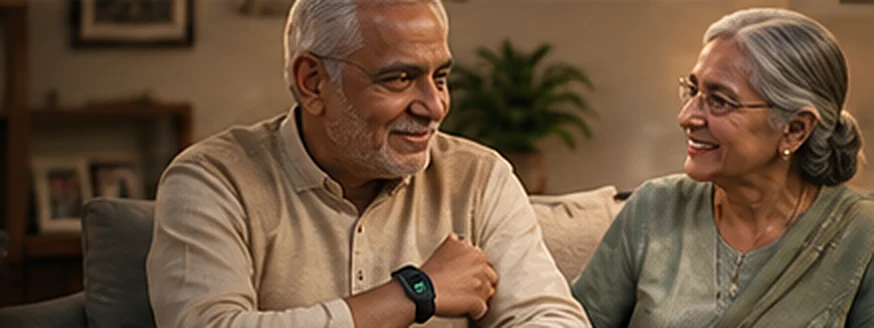
Why this needs more than a phone
The hardest part of eldercare at a distance is the gap between "something happened" and "someone knew". A fall in the bathroom at 6 am can go undiscovered until the maid arrives at 10, and with falls, those hours decide outcomes. Kavach's accelerometer and gyroscope detect a hard fall and start a 30-second countdown. If it is not dismissed in time, because your parent cannot reach the button, the band raises an SOS on its own, with their location, to up to three family members. Nobody has to find a phone, unlock it, or remember a number while hurt and frightened.
The second problem is technology itself. Smartphone safety apps assume a user who keeps a phone charged, carries it to the bathroom, and can operate it under stress: three assumptions that fail for many people in their seventies and eighties. The band asks for none of that. It goes on the wrist and stays there: up to 24 hours per charge, sealed against splashes so it stays on for washing (where many falls happen), its own 4G connection with a pre-activated SIM, and exactly one button that means "I need help".
And it protects independence rather than replacing it. The morning walk, the market, the temple: these are the routines that keep older people healthy, and also the ones families quietly discourage out of fear. Live location and a wrist-worn SOS change that maths. Your parents keep their routines, and you keep the ability to reach them in seconds if a routine goes wrong.
An SOS band for elderly parents, not a smartwatch
An SOS band does one thing a smartwatch does not: it asks nothing of the wearer. The Kavach Band has one physical button. Press and hold it for three seconds and an alert with live location goes to up to three family members over the band's own 4G connection, which keeps updating until someone marks it handled. There is no screen to unlock, no app on the wearer's side, no phone to carry, and the SOS works on the free tier for the life of the band. A plan never gates an alarm.
See the bandA safety band that detects falls on its own
The band's accelerometer and gyroscope flag a fall and start a 30-second countdown with a buzz. One press cancels it. If nobody presses, the band raises the SOS itself, with location, so a fall in the bathroom at 6 am does not wait for the maid at 10. Fall detection has been tested in our own trials and is not certified; it can miss a soft fall and it can trigger on a hard knock. We would rather say so than quote a number we cannot stand behind.
How fall detection works, and where it can be wrongWhat to look for in a senior safety band
Five checks before you buy any safety band for a parent in India. One: a physical SOS button, not a touchscreen gesture. Two: its own SIM, so it works when their phone is in another room or they have none. Three: fall detection with a cancel window, and a maker who says plainly whether it is certified. Four: a battery that lasts a full day, with charging simple enough for them to manage. Five: splash sealing, because the bathroom is where falls happen. The Kavach Band passes all five, and the one it passes with a caveat, fall detection, is the one we label tested rather than certified.
Compare the band with a smartwatchHow Kavach is used
Living alone
Automatic fall detection with a 30-second auto-SOS means a fall does not wait to be discovered. It announces itself, with location, to the whole family at once.
Children in another city or abroad
Live location and instant SOS alerts work across any distance. A daughter in Bengaluru or Boston sees the same alert at the same moment as the neighbour who can reach papa first.
The morning walk
The band goes where phones don't get taken: the 5 am walk, the terrace, the bathroom. One press reaches family; a fall reaches them automatically.
Early memory loss
For a parent in the early stages of dementia, geo-fencing alerts you if they leave home unexpectedly, and live GPS ends the nightmare of searching a neighbourhood street by street.
The moments it is built for
The bathroom fall
The most common serious fall in Indian homes happens on wet tile, without a phone in reach. The band is sealed against splashes, so it goes into the bathroom, and its fall detection works there.
A missed daily call
When the 7 pm call goes unanswered, the app answers the first questions, where they are and whether anything has been flagged, before panic sets in.
The temple and the market
The daily routine that keeps your parents active, now with a one-press lifeline that travels with them.
Post-surgery recovery
The months after a hip or knee operation are the highest fall-risk window of all. A band is easier to insist on than a full-time attendant.
Wandering risk
Geo-fence the house and colony. If dementia or confusion takes a parent past the boundary, you know in seconds, with a live map.
Common questions
My parents struggle with smartphones. Can they use this?
That is exactly who it is designed for. Your parents never touch an app. The band has no screen to navigate and one button to press. All the technology lives in the Kavach app on your phone: you see their location, get their alerts, and manage everything remotely.
What happens if my mother falls and is unconscious?
The band's accelerometer and gyroscope detect the fall and start a 30-second countdown with a buzz. If she is fine, she dismisses it with a press. If she does not, or cannot, the band automatically sends an SOS with her live location to up to three family members. No button press is required for help to go out.
Does it work in the bathroom, where most falls happen?
It is sealed against splashes and rain, so it stays on for washing and showering. We have not completed immersion testing, so we would not ask anyone to bathe or swim in it, and that is precisely when a phone is furthest away and the floor is most dangerous.
How often does it need charging, and can my father manage it?
A charge lasts up to 24 hours, around ten hours of it with GPS reporting every ten minutes, so it goes on the charger overnight the way a phone does. Charging is magnetic: the cable snaps into place on its own with no port to fumble, and reaches 80% in about 40 minutes. Many families charge it during the afternoon rest.
Can our whole family get the alerts?
Yes. Up to three contacts (siblings in different cities, a neighbour, the family doctor's clinic) receive every SOS and fall alert simultaneously, each with live location, so the nearest person moves first and everyone else stays informed.
Reserve a Kavach Band for your parents
Automatic fall detection, one-press SOS, all-day battery, nothing for them to learn. Pre-order now; no payment is taken until launch.
Count Me In →Guides for senior safety
- Best GPS Watch or Smartwatch for Senior Citizens in India 2026 (Honest Comparison)
- Best GPS Tracker for Elderly Parents in India (2026 Buyer's Guide)
- GPS Tracker Without SIM in India: Is It Possible? (2026 Guide)
- Fall Detection for Elderly: How It Actually Works (and Why Most Fail)
Kavach for everyone you care about: Child Safety · Women's Safety · Family Safety · Corporate Safety
Launching at Nashik Kumbh Mela
Don’t let distance become silence
In a crowd of millions, one press connects your family. Kavach debuts at Nashik Simhastha Kumbh, because no parent should ever wonder “where is my child?” and no child should ever feel alone.