
For businesses, B2B & B2G
Workforce Safety Bands: Keep Your Team Safe, Wherever They Work
Field engineers on highways, night-shift staff heading home, security guards on solitary rounds, sanitation and survey teams spread across a district: the people your operations depend on are often the hardest to reach in an emergency. Kavach puts a one-press SOS and live location on every wrist, with no smartphone, app training, or data plan per worker.
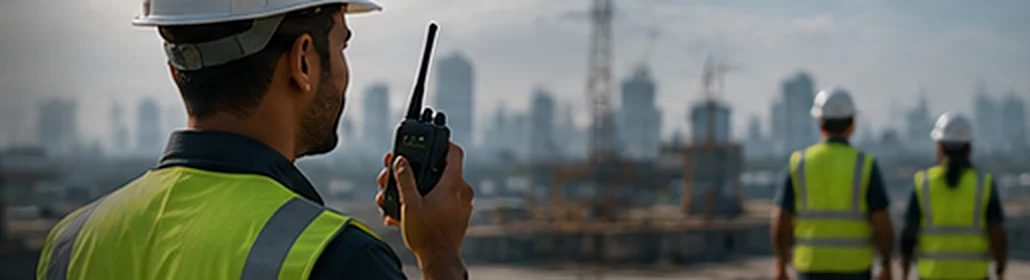
Why this needs more than a phone
Duty of care in the field usually runs on attendance apps and phone calls, which means it runs on each worker's personal phone, battery, and willingness to answer. That system fails exactly when it matters: a two-wheeler accident on a service route, a guard taken ill on a night round, a technician alone at a remote site. Kavach approaches it as infrastructure instead. Each band is a self-contained safety device, with its own 4G connection, an all-day battery, sealing against rain and dust for outdoor work, automatic fall detection, and a physical SOS that needs three seconds and no literacy, language, or smartphone skills to use.
Alerts route to the people you designate, up to three contacts per band: a supervisor, a control room number, a colleague on the same shift, the worker's family. Each receives live location the moment an SOS fires or a fall goes unanswered for 30 seconds. Store-and-forward GPS means a worker in a network dead zone still leaves a trail that uploads when coverage returns: relevant on highways, in basements, and across rural sites.
For organisations, the case is practical as much as humane. A visible, working safety system helps you retain staff for unpopular shifts, strengthens your position on statutory duty-of-care commitments for late-night travel, and turns "we tried calling him" into a timestamped, location-stamped record of response. We run structured pilots with businesses and government bodies: small fleets first, scaled on results.
How Kavach is used
Field service & survey teams
Technicians and surveyors work alone by design. Fall detection plus SOS covers the accident nobody witnesses; live location halves the time to reach them.
Night-shift & BPO staff transport
The commute between office and home is the highest-anxiety hour of the shift. Bands give employees a discreet trigger and give transport desks a live picture.
Security & facility staff
Lone guards on rounds, at gates, in basements. A wrist-worn SOS works where phones are prohibited, pocketed, or out of charge.
Government & public programmes
Sanitation workers, ASHA and anganwadi staff, disaster-response volunteers: bands need no smartphone or training, so they deploy across any workforce profile.
The moments it is built for
The lone two-wheeler accident
A field engineer comes off his bike on a service road at 7 am. Fall detection raises the alarm with coordinates. He never has to reach his phone.
The last drop of the night route
The employee dropped last, farthest from the office, has a three-second trigger and a live track her family and your transport desk can both see.
The remote site visit
No colleague within 40 km, patchy network. Store-and-forward GPS keeps the trail; the SOS fires the moment coverage exists.
The guard round at 3 am
A medical emergency on a solitary round becomes an alert to the control room and the nearest colleague simultaneously.
The audit question
"What is your emergency response system for lone workers?" gets an answer that is hardware, not a phone tree.
Common questions
Do our workers need smartphones or training?
No. The band is screen-free with a single physical button: press and hold for three seconds to call for help, with a buzz confirming the alert went out. Fall detection works with no action at all. Each band carries its own 4G connection and pre-activated SIM, so there is no app, data plan, or setup on the worker's side.
Where do the alerts go?
Each band routes its alerts to up to three contacts you configure: typically a supervisor, a control-room number, a shift colleague, and the worker's family. Every contact receives the SOS with live location simultaneously, so the nearest responder moves first.
Will the bands survive field conditions?
They are built for them: sealed against rain and dust with no exposed charging port, 28 grams so they are worn rather than pocketed, and up to 24 hours per charge so a missed night on the charger does not create a coverage gap. Magnetic charging reaches 80% in about 40 minutes.
How do we run a pilot?
We start small and structured: a defined team (a night-shift transport batch, one field crew, one guard detail) with alert routing configured for your operation, and success criteria agreed up front. Kavach is currently in pre-order with pilot deployments being scheduled; contact us and we will scope one for your team.
Is this available for government programmes?
Yes. B2G deployments are a core use case, from municipal field staff to event and pilgrimage safety. The band's no-smartphone, no-training design is what makes workforce-wide rollouts realistic. Write to us with your programme's context and scale.
Scope a pilot for your team
Wearable SOS for field teams, night shifts and lone workers, with no smartphones required. Tell us about your operation and we'll design a pilot.
Talk to Us →Guides for corporate safety
- Smartwatch vs Safety Band: Which Should You Actually Buy in 2026?
- GPS Tracker Without SIM in India: Is It Possible? (2026 Guide)
Kavach for everyone you care about: Child Safety · Senior Safety · Women's Safety · Family Safety
Launching at Nashik Kumbh Mela
Don’t let distance become silence
In a crowd of millions, one press connects your family. Kavach debuts at Nashik Simhastha Kumbh, because no parent should ever wonder “where is my child?” and no child should ever feel alone.